Planning Boiler Certificate Renewals Under the Boilers Act, 2025
Why a boiler's certificate for use must not lapse, what plants usually prepare for the renewal inspection, and how makers help plants plan it months ahead.
4 min read
By the Yantra Boilers team
Key takeaways
- A boiler needs a valid certificate for use to run lawfully; when the date on it passes, the boiler should stop until it is renewed.
- The Boilers Act, 2025 replaced the Indian Boilers Act, 1923. Procedures and forms are set by the rules and by each state's inspectorate, so check yours.
- Renewal means an inspection the boiler must be ready for: plan the shutdown, cleaning and papers weeks ahead.
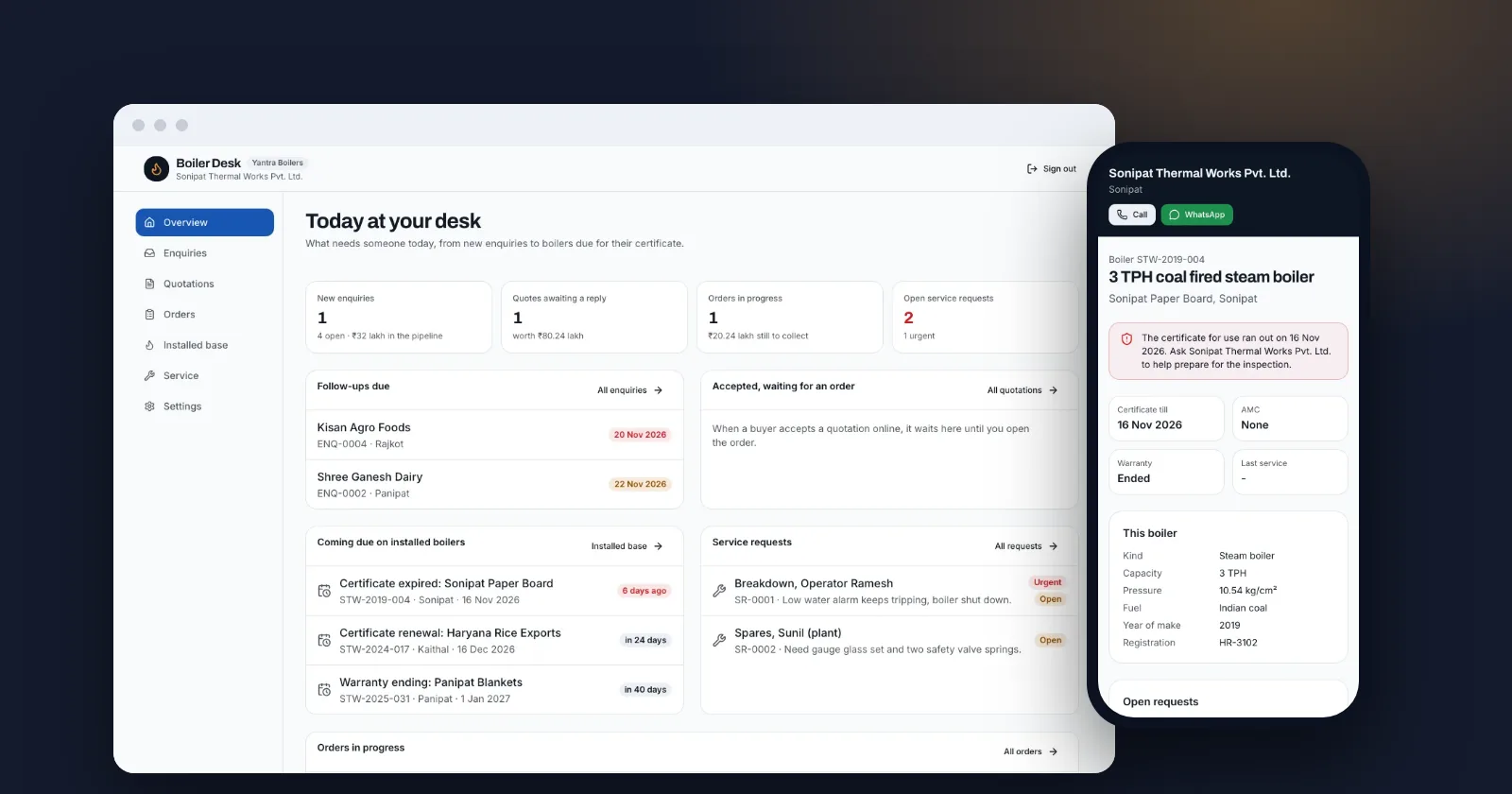
- Makers who track every boiler's certificate date can remind plants in time and offer to prepare the boiler.
The law changed in 2025
The Boilers Act, 2025 replaced the Indian Boilers Act, 1923, which had governed boilers for a century. It keeps the core idea, that boilers are registered and inspected and may only be used under a valid certificate, while modernising how it is done, including a role for authorised third-party inspection and a move from criminal penalties to monetary ones for most defaults. Regulations under the new Act govern the details, and states run the inspections.
The certificate for use
Every registered boiler has a certificate that allows it to be used, at a stated pressure, until a stated date. When that date passes, the boiler should not be run until the certificate is renewed. The period is the one written on the certificate: do not assume it, read it.
What renewal usually involves
Details vary by state, but plants commonly need to:
- Apply to the inspectorate before the certificate runs out, with the fee and the boiler’s registration details.
- Shut the boiler down, cool it, and open it up for internal inspection: manholes, mudholes and handholes open, scale and soot cleaned.
- Have a hydraulic test witnessed, where the inspector asks for one.
- Show calibration certificates for pressure gauges and records of repairs since the last inspection, including welder qualifications for any welding done.
- Fix anything the inspector finds before the certificate is issued.
For a new boiler, states have issued a provisional order allowing use for a limited period, commonly up to six months, while the steam test and final certificate are completed. Confirm what applies in your state.
Plan it months ahead
The inspection itself takes a day. Getting ready takes weeks: booking the inspector, scheduling a shutdown around production, cleaning, arranging gauge calibration and any repairs. A plant that starts ninety days ahead renews on time. A plant that notices the date the week before loses production.
What the maker can do
- Record the registration number and the certificate’s date for every boiler you supply.
- Remind the plant months ahead, and offer a pre-inspection service visit.
- Prepare the boiler: cleaning, checks of safety valves and water level controls, gauge calibration, and any repairs.
- Keep the drawings, test certificates and manufacturing documents the inspectorate may ask for.
Done well, renewal becomes a reliable annual service job instead of an emergency.
A renewal checklist
- Ninety days before the date: confirm the date on the certificate and the inspectorate's current procedure.
- Sixty days before: plan the shutdown with production, and book the maker or service contractor to prepare the boiler.
- Forty-five days before: apply for the inspection with the fee and documents the inspectorate asks for.
- Thirty days before: arrange gauge calibration and finish any repairs, with records for welding done.
- The week before: shut down, cool, open up and clean the boiler as the inspection requires.
- On the day: have the operator, the papers and, if needed, the maker's engineer present.
- After: file the renewed certificate and record its new date.
Why renewals get delayed
- The date was noticed too late to book an inspection before it.
- The boiler could not be shut down because production was running at full load.
- Gauge calibration certificates or repair records could not be found.
- The inspector found a defect that needed repair, and the repair took weeks.
Each of these is avoided by starting early. A maker who tracks every boiler’s certificate date can remind the plant in time and book the preparation visit before the plant even thinks of it.
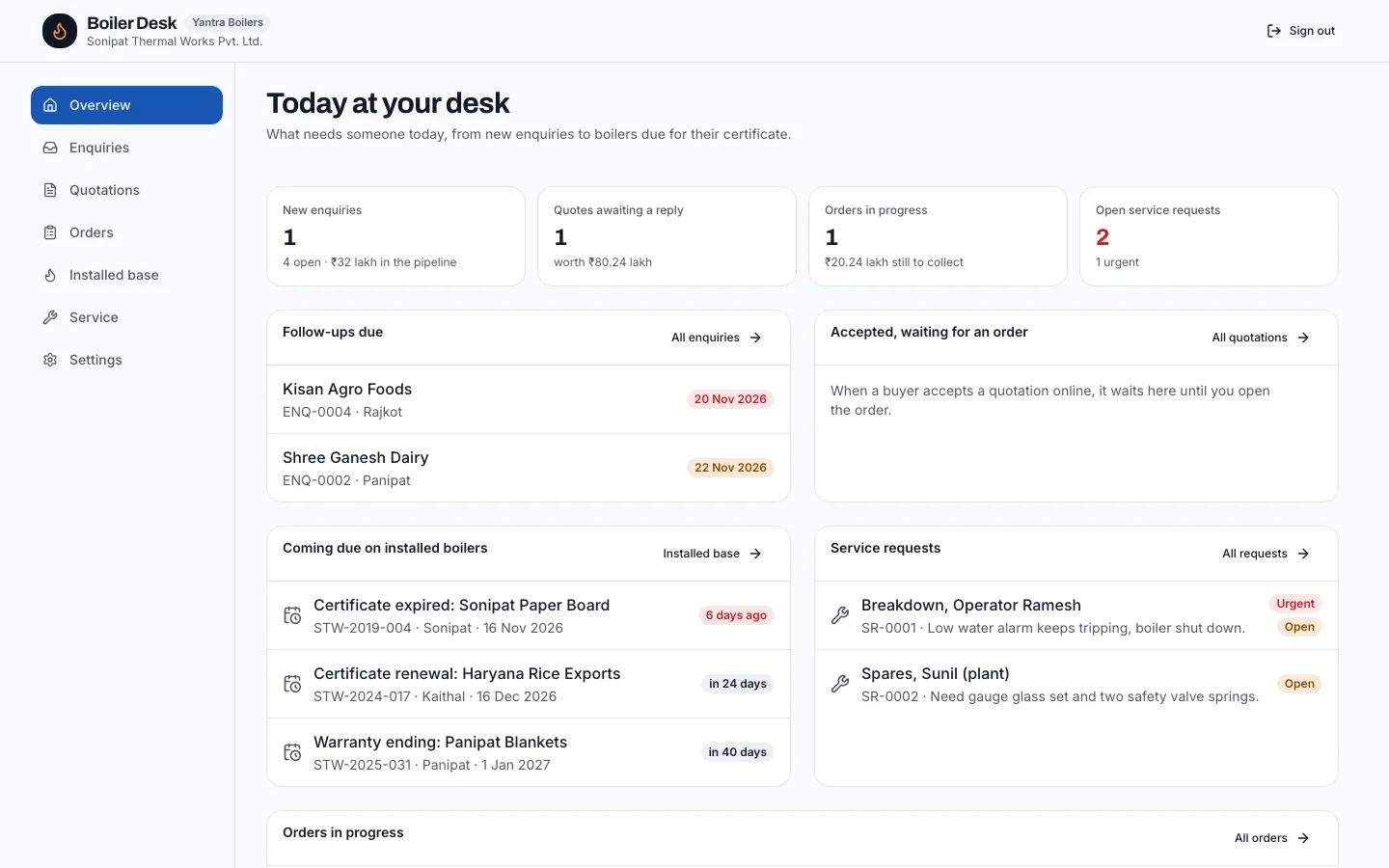
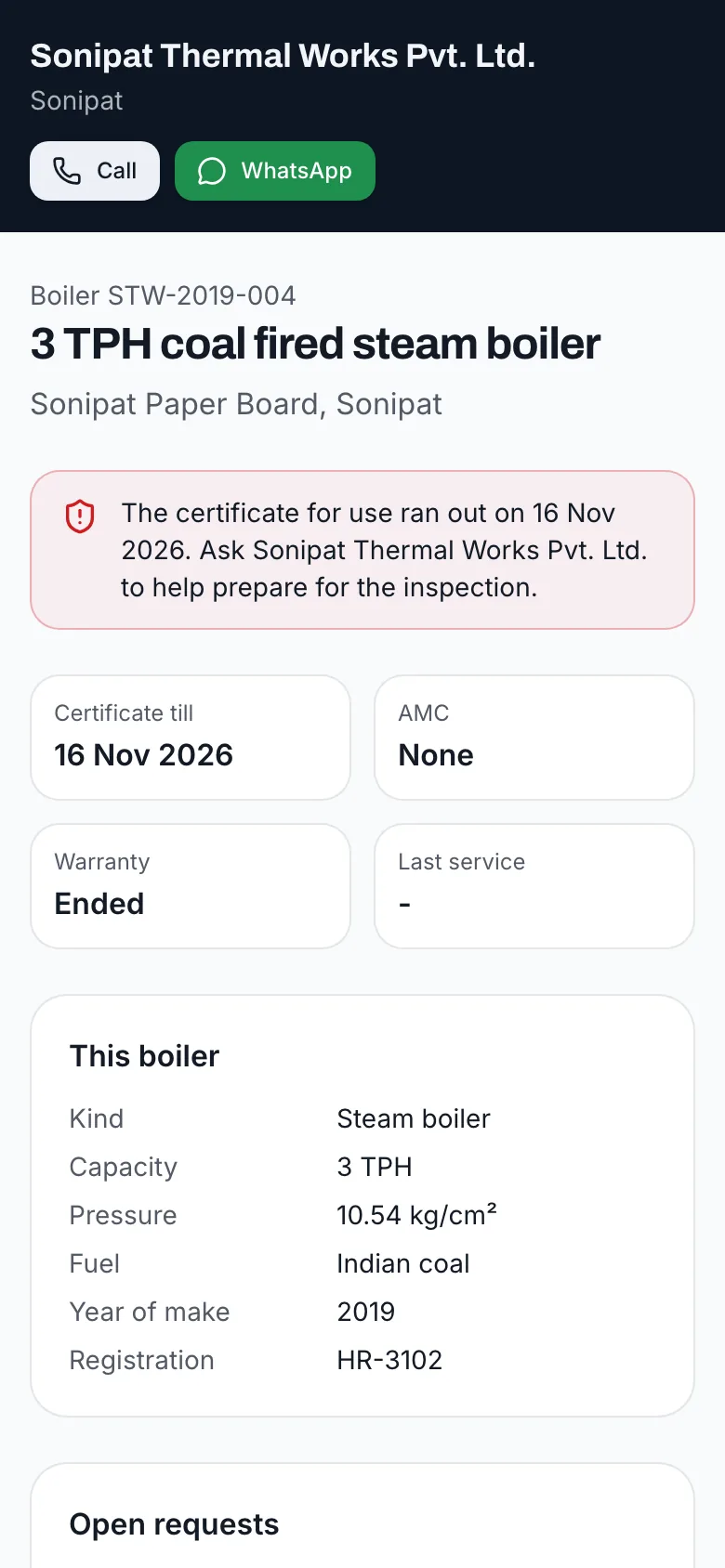
The plant can see it too. A QR code on the nameplate opens the boiler’s own page, which warns when the certificate is within thirty days of its date or has lapsed, next to a button to ask the maker for help.
Records worth keeping
- The registration number and every certificate, with its dates.
- Inspection reports and the inspector's remarks, and what was done about each.
- Calibration certificates for pressure gauges and safety valve settings.
- Repair records, including welders' qualifications for any welding on pressure parts.
- The boiler's drawings, test certificates and manufacturing documents from the maker.
- Water treatment and blow-down logs, which show how the boiler has been run.
Inspectors ask for these, and finding them the day before an inspection is how renewals slip. A maker who keeps the manufacturing documents and service records for every boiler it supplied can hand them over at once.
Third-party inspection
The new Act provides for inspection and certification by authorised third parties as well as by state inspectors, which may give plants more choice of when and by whom a boiler is inspected. How this works in your state, who is authorised and what it costs are matters for the regulations and the state inspectorate, so ask them before planning around it.
Frequently asked questions
- Can a boiler run while its certificate renewal is pending?
- Not once the date on the certificate has passed, unless the inspectorate has allowed it in writing. Apply and prepare early so the boiler is inspected before the date.
- Who is responsible for renewing the certificate?
- The boiler’s owner. Makers and service contractors help by reminding the plant, preparing the boiler and supplying documents.
- Did the Boilers Act, 2025 change the forms?
- The Act replaced the 1923 Act, and the regulations and state procedures under it set the forms and steps. Check the current ones with your state’s inspectorate rather than relying on older guides.